[ Home / * / RSS ] [ b / c / g / lit / guestbook ] [ k / a / min / t / m ] [ Deepswarm / Services ] [ Search / Rules / Mod ]

/b/ - Stochastic

"Alle Empfindungen stiegen bis zu einer niegekannten Höhe in ihm. Er durchlebte ein unendlich buntes Leben; starb und kam wieder, liebte bis zur höchsten Leidenschaft, und war dann wieder auf ewig von seiner Geliebten getrennt."
[Return][Go to bottom]
Name (Name could be empty, then a random name will be used from a pool.)
Options(sage: append your comment to a thread without bumping it; noko: after commenting, make your url stay inside the thread.)
Subject
Comment
File
Ext: jpg|jpeg|png|txt|conf|org|md|pdf|epub, Media:mp3|flac|webm; Max Size: 12M (Sum of all files);
Embed

Markup Guide

  • heading: use ## as 2nd heading and ### as 3rd.
  • inline code, use `
  • strong text, use **
  • italic text, use * or _ (single underscore)
  • slash the text, use ~~
  • underline the text, use __, enclosing text in double underscores.
  • Make hyperlink, directly paste url or use markdown syntax: [Link name](the url)
  • Goth the text, use [[ and ]]; Garamond the text, use (( and ))
  • Spolier the text, use ==; Make the text glowing, use ::
  • Make Kiketext, use ((( and )))
  • link inline meme/smiley, use double plus signs ++http://dswarmsikhttkg7jgsoyfiqpj3ighupfrvuz5ri3lu5q2dlqyrpgk7ad.onion/css/e/b0.webp++
  • code block, use ```:

    ```
    // comment
    some code
    ```

  • A place for testing markup: /test. I'll clean test threads from time to time, so use it when you're not sure.
  • Use >>NUM (double) to make reference in-board,
  • use >>>/SLUG/NUM (triple) to reference any post of any board.

     No.245

    日本文化是我见过的欧亚文化中所出现过的最让我反感的东西,不仅仅是反感现代的日本动漫和那些文盲精日,还有一些更传统体面的,包括茶道茶具文化。任何年轻人或者中年人,只要是中了“高贵”日本文化的邪,妥妥的奴隶道德持有者。
    我小时候喜欢看寺山修司,当然地下音乐也是必修课,看铃木清顺,但过了那几年,我认为我再也不会返回去去对这些感兴趣。当我阅读意大利人写的宗教长青哲学书籍时,里面时不时会提到日本文化的一些概念,我会感到一头雾水,因为我根本就不觉得日本的任何看似是“思想性“的东西跟我所关心的那些东西有真正的联系。我对佛教了解甚少,但是佛教文化所延伸出来的”茶道文化“一直令我恶心无比。现在四处都是那种白天徒步钓鱼晚上品茶做精神日本人的低级虚无佬,老婆也清一色文盲,人均管他们的钱+母老虎这种配置(男的假文艺吸引了文盲女:双向奔赴),有时候偶尔跟他们打个交道(一般是买东西,比如我最近买了茶筅,只是为了做抹茶拿铁用)他们恨不得把自己的尊严自己的ego秀你一脸。
    日本的登山品牌montbell做的最蠢,不小心碰一下我脑子里就长满了那种封闭家庭民族的优越感和莫名其妙的道德清高感的画面,那些搞户外咖啡搞装逼露营的美式日式复古男女就是从崇拜这些开始的,muji montbell etc. 的衣服设计非常虚伪,如果可以用虚伪这个词去形容服装设计,那就形容日本人所做的所有日本品牌的服装,肩部邋遢,袖子短,也绝对不会给你设计好什么肩缝,全部落肩处理,因为他们觉得真时髦,禅味十足,就差没说自己是“户外潮牌”了。我想过上一千年也别指望日本人会想到像始祖鸟那样做衣服,还function is beauty, 没看到function到底在哪,也没觉得beauty。。。
    日本的餐具风格最流行也看似最高级的是那种不对称的“手捏”感,还有什么手工锤纹,有时候看到那种餐具器具我真觉得我被侮辱了审美。我感觉我看到泥人在我眼前炫耀自己交配的姿势,就这样。
    日本的哲学就不用说了,从左翼到右翼到民族主义,到无政府,到现代,无一不是废物。跟海德格尔对过话的那个人势利地就差跪下来了(日本民族管这叫什么真诚)
    日本的haiku就更是笑掉大牙了,完全是假到不能再假的诗歌的代表,有些老中乐队还觉得haiku这个词特edgy做自己专辑名什么的,专辑内容就是抽烟喝酒日逼迷幻-“尊严”自我,跟日本精神确实一脉相承。
    我认为我除了未来可能会研究到禅宗-天台宗这类的中日宗教,应该不会光顾日本文化的任何方面了。不逛那些精日欧洲user的论坛也是这个原因,还spiritual呢,你跟我说你们在一个丑到不能再丑的日本风格imageboard上跟别的人聊“不能欣赏日本文化日本电影日本动漫的人是normie”时我真不知道spiritual这个词到底啥意思了。废物adhd intp/infp左派们求你们别再装模作样拿gnu/linux装逼拿日本文化充自己有文化有品味,我知道你们干什么都是为了交配,当你们说什么禁止"hate speech"禁止"反LGBTQ+"的时候,我寻思我要消灭的不就是这种人吗?就是反对你们啊。

     No.246

    >>245
    最装的就是sourcehut用户,sourcehut就是一个精日coder大舞台,以看似minimal的css著称,日本黑客感拉满。数年前sourcehut发了封莫名其妙的邮件,说从今往后要审查repo中是否存在反LGBTQ+的内容,我就立马删号跑路了,真笑掉大牙了。我看那些文盲poser到现在都不知道sourcehut ceo干了什么

     No.247

    >>245
    I guess I understand what you say, but I think it's like Chinese restaurants in western countries. Of course those are fake. Bunch of western people fetishize asian culture and some asian people make profit by selling those fake things. People who like Apple products. That's all.
    >Tea ceremony
    It's a heritage came from the long history of civil wars / military dictatorships. Those military leaders made 茶室 the sacred place for peace and humbleness without any killings. I don't think there's anything wrong in itself. The outside is already a bloodbath so what's wrong with making a place for peace? But normies have mimicked the military leaders and that's where it went somewhat wrong. Though I still think that it's not wrong in its essence.
    >Japanese concepts written by Italians
    Most ancient Greeks didn't know those ancient philosophers at that time. But that doesn't mean that those philosophers didn't exist. Well, for example most Japanese people nowadays "practice" Shinto. Contrary to the western belief, most Japanese people don't care about Zen. Why I used the word "practice" is that Shinto is a joke and people don't actually care about those deities except some famous ones like Amaterasu. Those deities give you fortune and that's all. It's rather a culture than a serious religion. But few people in Kyoto still sincerely study high theologies in Buddhism and live a strict life. And they have formed quite a serious culture around Kyoto. Those Italians focused on these few percentages of people and wrote as if it were a major thing. It's not. But that doesn't mean that these people do not exist.
    >low-level nihilists who hike during the day and taste tea at night to be spiritual
    I haven't known any Japanese people like that. I know many nihilists in Japan, but they don't care about tea. I guess it's a western meme?
    >Japanese clothes
    Not everyone in Japan buys these Uniqlo and Muji like things. It's a myth. In Japan, people buy them mostly because those are cheap. And not that horrible and still socially acceptable. But in the west, I guess these things are like Apple products and sell well. Though it's true that there are also some Japanese people influenced by western media who fell for its superficial understanding of Zen in the west.
    >Asymmetric handmade tableware
    I think in the end, it's just a matter of taste. I like them if those are actually handmade.
    >Mating posture
    I have no idea.
    >Haiku
    Because It IS a popular literature. First of all, "Haiku" is a westernized brand. Most Japanese write Senryuu and do not really care about Haiku. But western people often actually write a Senryuu and think that they wrote a Haiku lol. The goodness of Senryuu is that without the strict rules and just following 5-7-5, anyone can easily write a poem that sounds not that bad. Not gonna lie, I also enjoy reading interesting Senryuu written by literal whos. Full of creativity.

     No.248

    >>247
    I think the problem here is not only western perception of Japan, but Japan actively assembled a self-image that is extremely pretentious, while the actual contents behind the image is mediocre at best. Moreover increasingly native Japaneses are becoming tuned-in into this self-assembled image.
    The historical origin of Tea ceremony says nothing about the practice as it is in the modern form, since in this very behavior of mimicking something wrong comes into play, and it is, as I percept it, prevalent in modern Japanese culture. A sort of superficiality, and a sort of dissolution of "self" into an ocean of details and ceremonies, so that everything Japanese seems like that which will be exhibited by a closed society in the sense of Bergson (in his The Two Sources of Morality and Religion), and as you've mentioned, it is heavily Apple-like. It is explicitly illustrated and implicitly praised by Tanizaki Junichiro in his Sasame-Yuki, and it has its own beauty, but it is not beautiful as a participant, only as an outsider who is unaffected by the general pretentiousness that is exhibited by this attention to details and the dissolution of meaningfulness into mundane matters.
    >But few people in Kyoto still sincerely study high theologies in Buddhism and live a strict life. And they have formed quite a serious culture around Kyoto.
    Are you talking about Kitaro Nishida, Hajime Tanabe, etc? I don't think those Italians serious know these people, and when they wrote about stuff Japanese they were really just practicing wild western imagination. As for high theology, every country or culture with a minimum Buddhism influence will have some people studying the so-called high theologies, but it is really bizarre that westerners focus so much on Japan. I'm certainly not an expert in this area, but whenever I read something written by a Japanese philosopher etc. it just feels absolutely tedious and confused, repetitive, and never to the point; the best are written in a way that reminds one of textbooks, with attentions almost exclusively paid to mundane, pointless, details.
    Essentially, the point may be that modern Japan is a paradigmatic example of a closed society, in the sense of Bergson, and it just feels like a society/colony of, say, ants, sometimes.

     No.249

    >>247
    I wrote the Chinese text so wildly that there are absolutely some words the translator wasn't interpreting correctly.
    >low-level nihilists who hike during the day and taste tea at night to be spiritual
    I meant the group of "Chinese(real)-Japanese(mind)": Chinese who in their minds are very identified with the Japanese culture, so they are imaginatively Japanese, not really (tho they hope to be real Japanese like crazy). The term "to be spiritual" and the sentence structure was misinterpreted.
    >asymmetric handmade
    Let me explain the idea that handmade asymmetrical tableware is a degeneration. I was not trying to oppose handmade items, I am opposing asymmetrical tablewares.
    My point is this. The Japanese style of asymmetrical handmade tablewares that are deliberately created to convey a wabi-sabi vibe (loaded with meaningless splatter patterns) is a betrayal of the practical essence of tablewares. I don't like Japanese's tendency to elevate the mundane to a sense of art-ritual-sacredness, in reality this just ends up a kind of humanic "creation".
    Asymmetrical tablewares, just like their outdoor brand Montbell likes to make their softshell/hardshell jackets' designs to not follow the natural curves of the human body. Japanese clothing is always designed to look like a curved silkworm pupa, hiding the actual shape of the body. This is true even for "subculture" clothing (Harajuku fashion etc.). Harajuku fashion brands produce only oversized clothes. I think Japanese lolita fashion can be seen as an exception, especially gothic lolita brand like https://moi-meme-moitie.com/ there will be no such tendency, they are a modern successor of European aristocratic-romantic culture and also the modern heavymetal culture.
    This is a matter of practicality for daily-use items. Outdoor jackets and tablewares are included in this category. The pursuit of practicality or performance is the highest purpose that a designed everyday-object can achieve. It's notable that the pursuit of asymmetrical things is indeed an Eastern aesthetic habit that is contrary to the ancient Greek (FYI, Lovejoy's Essays in the History of Ideas, Chap. 7). Japanese have a special ability to spread this to all details of daily life and make degeneration extremely prolific, this is the image of the most low-level modern bougie-style.
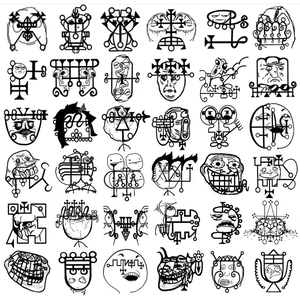
    To give a feeling in the case of art, see the two sculptures attached, this is a stretch to say but Japanese handmade asymmetrical tablewares is like the right one in the world of tableware.
    >everyday-life
    AFAIK, when the so-called Japanese counterculture prevailed in the 1960s and 70s, one of the results was young Japanese artists tried to actively transform everyday-life, thought that this is a new anti-art, the purposeless is the purpose. Even though they were Japanese in a new era - not traditional, so have been westernized more or less - they had an absolutely unique Japanese style and essense. The root is maybe in Japanese religions. Their traditional ceremonies, such as tea ceremony, ikebana, etc., are just fake ceremonies to me. They failed in sacredness, failed in aesthetics. When there are no gods, there is no sacredness. In the same words, if the so-called ceremonies are not intended to serve the real and direct dialogues, contactions with the "actual gods" (the "actual gods" is in the sense of Schelling's terminology), then it is just fake ceremonies for pretentious people to endure the essential emptiness of their lives (nothingness without content). I believe that in ancient times, Japanese should had some contacts with actual gods, since this history is universal. But now, I do not know.
    >muji
    Muji is not bougie and fake enough. Canadian Lululemon etc. are. Lululemon sells the same vibe as the Apple. Muji's European pricing policy is just like Arc'teryx's Asian pricing policy. Muji items are always have function-driven designs and are also cheap (I mean in China) considering the durable materials that being used. I was criticising their cloth designs and the ignorance of fabric chosen. I don't think Muji is similar to the Apple. I am not saying any capitalism topics here, just discussed the way they designed it. It is for dumb hopeless company employees, and their products are committed to forcing people to make unnecessary updates to the same products…
     No.250

    File: 1739262764032.png (459.93 KB, 791x630,imageMagick.png)


     No.251

    Long story short, there lacks a sincerity in these "beauty" they pursuit. Design should first and foremost be practical, this is not a utilitarian mindset, simply that ornaments and appearance should have something more than mere appearance beneath them. Either symbolic of something that is real, that is alive, or possessing practical values so that visual form isn't decoupled from the very essence of the object. Basically, there is no genuine tradition left, no traditional cosmology left, and there also lacks a spirit of high modernism; you don't need to be a high modernist to have a spirit of high modernism, even implicitly.
    And this phenomena isn't solely in design. It is literally everywhere. It is like their manner - they are absolutely polite and westerners praise that, but they also tend to hold grudges easily, tend to speak ill of people when they're no around - this may not be true since it is just my personal experience. Appearance rules, vibe and what "seems" rule, truth and reality and meaning don't matter. True, we know that nearly no one really cares about Buddhism and Shinto is also merely a half-dead culture, but traces are everywhere, the general cultural climate is that of a specific strand of Buddhism that is characteristically un-philosophical and focuses almost exclusively on some sort of vibe. In China Buddhism has degenerated into worship of money-god and Chinese "Buddhism" value success, health, wealth over everything else. In Japan it has become a condensation of vibe.
    When it comes to practical matter, yes, contrary to imagination, average Japaneses are very practical, they shop in 100円ショップ, and they don't eat sushi and sashimi day and night (the global praise of Japanese food is another bizarre phenomenom that makes absolutely zero sense), but when it comes to these matters it is just housewife practicality. There's a sense of warmth, of everyday life here, but it is impeded by the stifling politeness and strict social rules, and it is possible, as I can judge, solely due to the messy details and mundane chores that Japanese form of life is literally filled with - they just prevent people - in general certainly there will be exceptions - from knowing anything genuinely higher. I'll say in, say, China you'll have really absolutely degenerate people, but you can also easily be free from the degeneracy since the culture, or better still, form of life doesn't take hold of people, but in Japan I'll say no, as I've observed it is even hard for Japanese people to comprehend what it means to be free from that form of life in which for me they are imprisoned.
    Strangely enough whenever Japan/some random Japanese people do something, there's always a bunch of people praising it, while oftentimes it just absolutely sucks and makes zero sense. I've never seen anyone praising Deutsche Bahn after they've experienced it, but when it comes to Japan it is just idk wth.

     No.252

    >>251
    First of all, thank you for additional explanations. Since the translator is far from perfect, at some points I read fully with pure imaginations.
    >Japanese self-image
    Well I don't think this is an actual self-image. It is rather a social pressure. I guess this is why you say about a closed society. I somewhat agree. This is Apple-like.
    >Tanizaki Junichiro and Italians
    Not related to the topic, but mentioning Tanizaki Junichiro right before the Italians made me remind of Umberto Eco prasing In Praise of
    Shadows lol.
    >Asymmetrical tableware
    I totally agree with that one doesn't need to needlessly make things unpractical. This is also why I hate normies mimicking. In my opinion, the most disgusting thing in this category is that the tablewares and ceramics which were originally a symbol for frugality now cost over 6 figures in some cases. What the heck. This is definitely an Apple-like phenomenon. Fuck those normies.
    Why I wrote about the historical origin is that I think it essentially comes from the historical origin. Buddhism is in fact supplementary. It vibed well with the historical situation. I know that this is quite a Marxist view of history and I don't like it, but this is what I think. Why it is wabi-sabi is because of the bloodbaths outside in those times (Muromachi - Sengoku - Azuchimomoyama). And the tablewares for tea ceremony are not everyday items. The historical situation gave (especially) the military class an existential crisis. As a reponse to that, the backborn of the traditional Japanese culture has been created.
    You might hate it and say that it is a fake without actual sacredness, but I still like its existentialism. But again I totally agree with that needlessly making everyday things wabi-sabi is just self-deprecating. Things in the nature or handmade things are usually uneven, ugly and do not last long. Having a compassion for these things alone is almost sufficient, without a need to intentionally make things outsid
    e of tea ceremony worse.
    >Politeness
    This is just a Fe issue. I totally understand since I'm a Fi user and don't want to lie. Honestly speaking, I still have issues about Fe. But… I try to respect it as the hedgehog's dilemma. And I think trying to make people happy and comfy even if one is unhappy is not a blameable thing. Especially if the tries are genuine.
    Besides that, this is also because Japanese people simply don't have high confidence. Low confidence seems like humbleness and politeness.
    >Appearance rules
    True but this is not Japanese specific. Even early ancient Greeks before introducing logos were like that.
    >Fetishizing Japan
    I guess this is somewhat because of Japan having been the capitalism front. Many other Asian countries were socialists or in the third world.

     No.253

    >>252
    There are two people replying to you. I've never mentioned anything regarding ancient Greek, and I highly doubt what you're saying, since we simply do not have enough source about ancient Greek thoughts before Heraclitus. There are legends and folklore, but these aren't enough.
    Moreover it is simply false when you consider the major part of humanity. For moderns who distinguish between things transcendent and immanent, and who make demarcations between the natural and the supernatural, it might be the case that ancient people focused on the appearance, but as I've read from history of religions and anthropology, and maybe more, from various art history and depth psychology, while they were empirical and focused on the phenomenological world, it is simply no the same type of appearance that they were focusing on.
    Especially the ancients were highly attuned to a traditional cosmology with immanent symbolic contents immanent, it is nearly impossible for the ancient Greeks to be focusing on the appearance in the modern sense. It is only after the first axial age that philosophies like Buddhism become possible, and only after the second axial age - I'm referring to the period from the late Middle ages to early modern period and especially Reformation - that the concept of pure transcendence in the sense that objects with no world-immanent symbolic content, which are decoupled from a cosmic order, become possible. How comes the ancient Greeks before Heraclitus were the same? It just doesn't make any sense. And why "even" early ancient Greeks? In my own understanding there's nothing special about ancient Greeks, they don't represent anything that is non-appearance driven. As analyzed by Tatarkiewicz they were rather the most superficial people in the ancient world who accidently become revered as the "philosophical" people, at least when compared with the Hindus and the "Abrahamic races" they were much more Einfühlung driven and not driven by Abstraktion, even the Germanic people were more philosophical. Maybe there are two kinds of being philosophical, the Greeks may be philosophical in the sense of being analytical, though not analytical like the moderns, but they were never philosophical in the sense of in touch with the divine and with what's now called symbolic.
    >Politeness
    It is a fake politeness with literally no dignity and no genuine kindness. There are many forms of Fe but that sort of nearly toxic Fe-ness is almost verging towards pathological. Also it is fake in that I'm pretty sure issues like school bullying, and work-place bullying, weren't less problematic in Japan, and maybe the direct opposite. It is not solely Fe, it is "mannerism" - sadly this word is already taken.

     No.254

    >>253
    >Ancient Greeks
    What I refered was, check the chapter 16 of "Against Method" by Feyerabend. I think if you use a PDF, searching "logos" might lead you to the quote of Heraclitus. The part around the quote. I don't have the book right now and since there are various editions, sorry for being not able to directly point out.
    Of course ancient Greek epistemelogy was far different from the modern one. All I wanted to point out is just that it is not specific to Japanese culture.
    >"even"
    I did not intend that Greeks are special. Compared to other cultures around that time like Egyptions for example, Greeks were noisy plebs who always make troubles. Why I used the word "even" is just to stress out. No serious meaning.
    >Politeness
    According to your writing, what you refered to seems rather unhealthy Si than politeness. Then I'm not going to defend it and I don't want to. Things like Senpai-Kouhai hierarchy or school caste suck. But it has nothing to do with Omotenashi so that it was not my point. Those two are different things.

     No.255

    >>254
    And all I wanted to pointed out was that, what I'm referring to is such a thing that is most prevalent and observable in Japanese culture, and it is an exclusively modern thing that is basically impossible in any culture that is before the second axial age, Japanese included; that's the reason I mentioned high modernism and the lack of the spirit therein. The point is not just "appearance", the point is, now that the whole humanity is basically Christianized and all the traditial cosmologies are factually gone, people basically have been indoctrinated into this "logos" and already possess a general distrust of the phenomenological and the superficially empirical so that there's no way back, modern Japanese culture is still largely built around a dead cosmology.
    I'm not the site owner, so I may have some very different opinion towards, say, Varg Vikernes. I think Varg Vikernes is laughable, since he just doesn't understand the traditional mindset and in his cognition the ancient gods are just metaphors, while for the ancients the gods are definitely more real than he himself. He's an epic cosplayer. He doesn't care about being true and doesn't care about genuine meaning and is trying to cosplay himself through the vast ocean of facts and deceive himself, and this is exactly what I perceive in modern Japanese culture. It is not simple normie cosplaying, the whole culture has a tendency to cosplay, to construct a vibe, an "aesthetic" that has no content.
    Here I'm actually going Nietzschean, since for me Nietzsche should be read together with the whole strand of futurism, modernism, and read by people who have real knowledge of western history of ideas and anthropology, not by bloody atheists or whatever, so that they actually know what Eliade et al were doing and can in turn understand what Nietzsche was doing. Nietzsche saw through that the 18th century Christianity is built upon a sham, either it be the rational-classical cosmology of the scholastics, or the more traditional cosmology that Mircea Eliade et al were referring to, had stopped functioning, so he exposed it, but curiously modern Japan seems to cling onto the dead and the false, pretending that the tradition is still alive. People don't really care about Shinto and maybe Buddhism, but the outward appearance of the culture is still Shinto and Buddhist, and similar fake aesthetics that has no real, actual content, since the corresponding content can only be present with the corresponding cosmology being present. If there is not a corresponding symbolic order/hierarchical cosmos that supports the aesthetics, then it is false, and all the ornaments and "tastes" that comes with it should be eliminated, and western culture had already gone through the process in the early 20th century, but in modern Japan only the most superficial culture is transformed. Also judging from Tanizaki Junichiro's writings, especially In Praise of Shadows, they don't want to transform it. It is not that they should accept the whole modernist agenda (by modernist I'm referring to Eric Gill, Adolf Loos, Le Corbusier, etc.), but I've never seen any serious attempt in transformation. "If it works for now and we can live on, then why change?" This is also quite "Zen", in a sort of ironical sense. There is really a lack of depth, and this lack of depth and unwillingness to confront the reality propagates to the whole culture; it is easily detectable.
    I'm not sure about the judgement towards Egyptians since the Greeks idolized Egyptians just like how modern westerners fetish China or Japan, and all those occult stuff was actually compiled in the later ages, around late Middle ages. They built some good architectures, and all their stuff seem mysterious (in picture, but if you see them IRL, for example been to Egypt or been to Louvre and saw the real stuff it all vanishes and you'll be starting to admire the Mesopotamians), and had a very detailed concept, maybe philosophy, of human "soul", and the theology encoded in their mythology, unfortunately or fortunately never explicitly worked out as theology, was superb, but to me it seems that they had arguably the most dull culture imaginable. Egypt is interesting solely because it is the most "symbolic" civilization, the whole civilization is a crystalized (but not incarnated) mythology, and I like what Rosenstock-Hussey wrote about Egypt in his I am an Impure Thinker though I guess it is largely projection and imagination.

     No.256

    >>254
    >Si
    Yeah this is true. I think so. Guess it is Si, so that outwardly people can be extremely friendly to the point that some sensitive people may become uncomfortable, but beneath the veil… and in general westerners won't ever have the chance to see through the veil. I have no problem with Omotenashi, in so far as it is be mindful of others and try not to cause trouble and try to care about others, but I think this is different from a general vibe that constrains people and breeds resentment in people, though I think Japanese people won't feel such a thing. Personally in daily life I'm just like a Japanese, just without those excessive apologies and self-effacement, but I think there's always a threshold, which, when above it, it becomes fake and pathological, especially when it makes people hyperconscious about their behavior in the sense of manner and appropriateness, so that mutual respect becomes something without dignity and self-respect, becomes not the mutual respect of persons, but mutual respect of swarm constituents, something that is autopoietically assembling itself out of inertia rather than something that should be learned and grasped individually.

     No.257

    >>255
    BTW thank you for this conversation since when I'm writing I finally found the right word that I have been constantly in search of for years. Yes, the Egyptian civilization is a crystalized mythology, they crystalized symbols, but not an incarnated mythology, and certainly they never incarnated symbol. It all makes sense now. So summarizingly I can say that the crucial thing is whether the symbols are incarnated in person, rather than merely symbolized through various mediums, to the point that when some symbols just become dead people are still holding onto them, without even realizing that they are dead.

     No.259

    >>255
    I see your points. But… the problem is that it is more of ideology. I can't really deny your arguments. But still ideologically I deny. So I guess I should end after writing this.
    Although I'm not from Kyoto, I genuinely think that Kyoto is still the mental capital and the heart of Japan. But you already know that the capital of Japan is Tokyo. Compared to Kyoto, Edo was the city of samurais and merchants who followed Confucianism. After modernization, it has become the center of modernism and capitalism. And I have never liked Tokyo. I secretly regard Kanto as Confucian bugmen transformed into modernism city dwellers. Of course there are many people who went to the capital city to get a job. So I don't necessarily disregard people who live in Tokyo. But they are still city dwellers. Kyoto is also a city, but anyone who has visited Kyoto even once knows that Kyoto is not a typical modern city. I don't know, it might be just because of the height limit of buildings and remained traditional buildings. But it still doesn't feel like a typical city anyway.
    Because of the centralization and the low fertility of Japan, anywhere outside Tokyo is declining. Although it is not the only reason, it certainly triggers some people outside Tokyo. And when it comes to Kyoto, there are some people thinking that modernization was a mistake. Sure, if you consider nationwide, those people are few. Bank notes are still full of people about modernization. But they exist anyway.
    I just quite agree with those people. I don't really believe in Buddhism or things like that and I care western religions much more, but I highly respect what-so-called "Zen influenced traditional culture" around Kyoto and few sincere people of it. Maybe it's just me hating modernism and finding allies. The traditional worldview strongly contradicts to modernism after all.
    So honestly, I don't really care about "Japan" and whether you hate or not. It was interesting that you two hate enthusiastically so that I bited the lure. But I highly respect the traditional culture and hate modernism, although I don't really believe in Buddhism. That's all. No more and no less.

     No.260

    >>259
    I think you still don't get that the problem is not with the traditional culture, but with the fact that the traditional culture, if there is no cosmology that supports it, then it is dead. And I don't like Tokyo either, it is not that special that someone thinks modernization was a mistake, but it happened. The problem is not with whether to modernize, but with how to properly modernize.
    I see, here you simply just don't want to learn about what actually happened during modernization, and your point of view is nearly excessively from the point of economics etc. when it comes to modernization. But modernization happened, and it happened before 16th century. The beginning of the Reformation is the beginning of the modern age, and modernization was determined to happen. You simply don't want to comprehend what I am talking about when I'm using the word modernization, and you actually never carefully read what I wrote.

     No.261

    >>260
    No I understand what you wrote. I just don't want to accept it. A part of me is still wanting it to exist even if the actual content is gone thus fake.
    So in fact it's purely my fault. That's why I think that I should finish this discussion.

     No.262

    >>260
    I guess the problem is similar to modern paganism, but in this case it still outwardly exists and is not a total revival like paganism.

     No.263

    >>260
    …though I want rather Renaissance than modern paganism. Though I also know that Renaissance scholars did a cosplay of ancient men but couldn't become…

     No.264

    Sorry for my ugly monologues.

     No.265

    >>260
    By the way, I think you don't need to use big words for that. A simple sentence "People don't actually live like that anymore" is sufficient. More than that is just bloat. Thank you for your criticism.

     No.266

    >>265
    It is not as simple as "people don't actually live like that anymore" and I've never used any big words. Here what is at stake is rather than a way of living and the socio-technological condition, the concept of human being, and what constitutes human soul, the nature of human agency, and what's the point of life, etc. You may look at the outward manifestation of a metaphysical change and deem the outward manifestation as what's crucial, and be a scientific materialist at heart while denying the fact, of course.
    The transformation that happened was, while salvation or perfection or whatever was an act of ascending a hierarchy by means of conforming to the natural rhythm of the cosmos prior to the second axial age, after that it became genuinely transcendental, hence meaning and purpose of life and goodness etc. all decoupled from the natural order, etc. So at the end of the day you really didn't understand what I meant.

     No.267

    >>266
    When we are talking about what is good and what is bad and what is genuine, we don't simply look at whether a set of acts conform to the current socio-technological condition, but what is true and meaningful, and that's the whole point of doing philosophy. If I regarded you as a random normie and a random brainlet I will not have used those "big words". Now since I thought you were someone who can actually reason into the core of a problem, I tried to get into the bottom - while not actually THE bottom - by touching things that has soemthing to do with world-process and genuine religion. By genuine religion what is meant is an utter repsect of the meaning of life as it is, rather than by pursuing a so-called tradition revive a certain sort of lifestyle or form of life that people somehow instinctively think is better. Of course the premise for making these statements regarding religion is that your religion is western and is "tainted" by the Abrahamic element - while some will say it is "gnostic", so that human agency and what you do matters, so that you're an actor in a cosmos that is a process with a dynamic order and genuine future, and is to be completed at the end of time, rather than a constituent of a natural order that is eternal.
    If you're simply someone who is interested in the socio-economic aspect of religion/culture, then good, it is OK to say that "people don't live like that anymore".

     No.268

    >>267
    BTW.. I don't care whether a thought current is true to its origin, and while the Renaissance is certainly not true to its origin, it is not fake with respect to both the societal and the spiritual change that was taking place. It was an age during which the scholastic tradition has reached its pinnacle and is in a state of stagnation, and while in my own opinion the Renaissance was largely a mistake and should be seen through the lense of the provencal religious current that encompasses Waldensian and Albigensian heresies, it was at least not fake spiritually. Also I'm not really sure whether you really have any true knowledge of the writings of, say, Pico della Mirandolla and Ficino, I think it is self-contradictory to love the so-called tradition and the Renaissance since the latter is in its essence "modern", and the occult elements and magical thinkings presented there were so common in that period so that it is hard to say that they are characteristically Renaissance. Fludd, Ficino, Agrippa, these people were really just surfacing during a period when the scholastic "rationalism" was in decline, and not that curiosly rationalism is in conlict with, say, modern "scientific" materialism; after all Boyle left a volume of recipes for home remedies that looks just like witchcraft (culled from an oak at the full moon, mistletoe berries dried, powered and mixed with black cherry water, will cure epilepsy" etc.) for modern minds. Some aspects of the occult are genuine philosophy, but most of them were no different from love potion recepies, or whether eating the genitals of a certain animal will improve one's this and that… It is decisively not "traditonal" when this tradition is something that is different from crude shamanism and is something that the vibe of Kyoto will remind people of. Shamanism, now some may think it is cool, while they abhor those performances given by actual shamans in, say, Manchu, in which people dance in front of the head of a slaughtered pig with cashes in its mouth…

     No.269

    >>265
    >is sufficient
    >is just bloat
    >thank you for
    Honestly I felt a strong sense of melancholy and despair, it's very existentialistic. The notion of "de-bloat" that Luke Smith likes to use seems to me to explain only part of technological life.
    For me a life that always concerns about the purity of technologies or purity in general is not even worth pursuing since that is already there to some extent. We already know the answer for this kind of practical things.

     No.270

    >>269
    Luke doesn't really reason. He has many opinions but there's a basic lack of "philosophy", in that his positions are self-contradictory. He wants independence, but his independence is built upon a general dependence, and moreover a sham. It doesn't mean that his opponents are correct. Both of them simply don't want to think about, say, the point of doing some stuff. They already have the conclusion, or they don't even comprehend the fact that the point of doing something actually matters, and is something that should be pondered upon and examined. I've observed that many who idolize the orthodox church has this attitude. It is like they try to find a secure point of view that is immune from all criticism, since they can accuse those who criticize the orthodox church as progressivist who don't understand the serene beauty of the ancient way and are brainwashed by modern capitalism etc. etc.
    The problem is not with purity itself but a false sense of purity. I'll say that this is actually apple-product mindset. So you have a false appearance that looks pure, then what you're doing must be pure, which is plainly false. Luck Smith idolizes the orthodox church and says the catholic church likes to add dogmas which he doesn't like, as if not adding any dogmas is the right and pure and TRADITIONAL thing to do, while the so-called tradition is itself a result of ages of conflict and transformation, and what is really "traditional" is, in contrast to the so-called tradition that the protestant or orthodox resistance to the apostolic constitution Munificentissimus Deus relies upon,
    >there was a deep longing in the masses for an intercessor and mediatrix who would at last take her place alongside the Holy Trinity and be received as the “Queen of Heaven and Bride at the heavenly court.” For more than a thousand years it had been taken for granted that the Mother of God dwelt there […]
    People invent tradition and "purity" without ever trying to dig deeper into their concept of purity and how they are shaped. They think the past or the tradition or whatever is an static entity that doesn't depend on the perspective one takes to comprehend the general shape of it. Moreover, they don't try to put themselves into the shoes of those who lived and thought in the past. This I'll say is due to a general lack of historical consciousness, and an unwillingness to think. They find a position that seems different from the masses and take pride in it without ever reflecting on whether this position they decided to take makes sense.
    Of course I know Luke is simply copy-pasting some popular polemic books and articles, and many so-called Christians never really cared about their faith but like to copy-paste, just like many so-called philosophical people can't even do one line of philosophy properly.